

The Model Eats the Sculpture
it carries the argument’s central image, states a claim a reader can immediately disagree with, and the subtitle converts a sculptor’s private habit into a problem the photographer recognises as their

A scale model can starve the sculpture it was made for.
In a studio in Centocelle, on the eastern edge of Rome, iron stock leans against finished work, and the drawings pinned up nearby are quick, unmeasured things. Their job is to put the presence of a piece in the room while its maker settles how the installation will sit. They stay inaccurate on purpose. A proper scale model absorbs the energy, Lulù Nuti says, and by the time she reaches the forge that energy is spent.
The transmission is stranger still. Since 2017 her wrought iron has been forged by the blacksmith Jadran Stenico, and Nuti conveys what a piece should do by moving — her body traces the line the metal is meant to take in the air, rather than handing over a sheet he could measure.
Studio superstition, on the face of it. What she describes is mechanical, though, and it applies to you more directly than it applies to her.
The claim worth taking from her is narrow and contestable: preparation detailed enough to be checked against is preparation detailed enough to stop you looking. It argues against the doctrine most of us were taught — that a photograph should exist complete in the mind before the exposure, and that everything afterwards is execution. Pre-visualisation, the mood board, the shot list, the reference deck, the storyboard drawn to scale. Serious people work this way. Clients pay for it, and often pay precisely because it removes doubt from the day.
Effort is not what separates the two positions. Both kinds of preparation cost the same hours. One of them can be subtracted from the finished work; the other cannot.
What the model takes
The anthropologist Tim Ingold gives the assumption behind that doctrine a name: hylomorphic, form conceived in a mind and then pressed onto matter that waits, inert, to receive it. In “The Textility of Making” he traces its hardening to Alberti, who specified a building on paper down to its lineaments — everything settled by the intellect in advance of any stone — so that construction became the faithful reproduction of a drawing. Ingold’s counter-proposal is that form arises inside the flow of the material itself, and that a maker follows it rather than dictates to it.
You can find the metaphysics overstated and still notice the practical effect, which is a change in what your attention is for. Search and verification are different activities, and a complete specification converts the first into the second. On location, with the reference open on your phone, you are no longer looking at what is in front of you. You are auditing it.
So write the plan as a sentence rather than a picture. Before a shoot, put down one line naming the problem the photograph has to solve — two people who will not look at each other, in light that refuses to explain them — and carry no reference image at all. A sentence under-specifies: twenty different photographs satisfy it, and you will know one when it turns up. An image specifies completely, and then only one thing satisfies it, so the day becomes a hunt for a match you already own.
Forsythe built a training tool for improvisers
The obvious objection is that all this romanticises not knowing what you want. Most unprepared shoots produce nothing, and the practitioner who trusts the moment is frequently the one who has never worked out what they are after. An art director who has paid for a crew, a location and four hours of usable light is owed a description of what will be delivered. Worse for my argument: the looseness you admire in other people’s photographs is usually the residue of preparation you never saw — the fortieth visit to the same corner, the year spent learning what that street does in November.
Concede all of it, because it is true. The axis runs somewhere other than prepared against unprepared.
A dancer sits at a screen. On it a body moves, and thin animated white lines follow the limbs, tracing the geometry a movement leaves behind in the air. Sixty chapters of this. Sixty chapters of this. It was built as an in-house training tool at Ballett Frankfurt, then published in 1999 by ZKM Karlsruhe with the German dance archive in Cologne: William Forsythe’s Improvisation Technologies, subtitled A Tool for the Analytical Dance Eye. Years of production, considerable expense, an elaborate apparatus — all of it so that his dancers could improvise better.
None of it fixed an outcome. What it made explicit were operations: ways to see a line, to fold a movement around a point, to read what the body had just done and continue it. A dancer who has absorbed that arrives with more available responses, not with fewer. The rehearsal enlarged the range of the moment instead of pre-empting it.
That is the distinction Nuti is reaching for when she mimes a curve at a blacksmith instead of drafting it. Preparation that settles what will happen leaves less to happen. Preparation that increases what you can do when something happens leaves more.
Keep the deck and the working document separate, then. The client’s deck has to answer the question, and pretending otherwise loses you the job. The page you carry on the day should hold the problem sentence and the operations you intend to have available — the two focal lengths you will hold yourself to, the one thing you will do if the light collapses. Nothing on it should describe a finished photograph.
Two figures against a dark ground
Two people stand against a dark ground, facing the camera. A chain runs from one to the other. One of them is steadier than the other, and holds the pose; the second is somewhere else entirely. The photograph is printed at nearly life size, so that in the room you meet them at your own height and the encounter arrives through your body before it arrives as a picture.
Chien-Chi Chang made those photographs at the Lung Fa Tang temple in Kaohsiung in 1998, where hundreds of psychiatric patients lived chained together in pairs. The Chain went to the Venice Biennale in 2001 and to São Paulo the following year.
The decision doing most of the work there is the scale, and the scale is not in the photograph. It concerns the wall, the room, the distance a stranger will stand at. No pre-visualisation contains it, because it is not a property of the exposure at all.
Nuti learned this from a stranger. At a student show in Paris, a man walked straight to her first sculpture and shook it, hard. She told him to stop; he looked at her and said it was made for that. Her teacher’s verdict afterwards was that she had discovered the difference between a work hung flat and an object in space — the object takes up room a person could otherwise have stood in.
Prints do that too. Photographers forget it because a file has no size, and because the doctrine trains you to finish the work at the moment of exposure. Some of the strongest decisions available to you get made months later, by which time the plan you followed on the day has no jurisdiction.
Give away the decision you care most about
Sanne De Wilde handed over the colour.
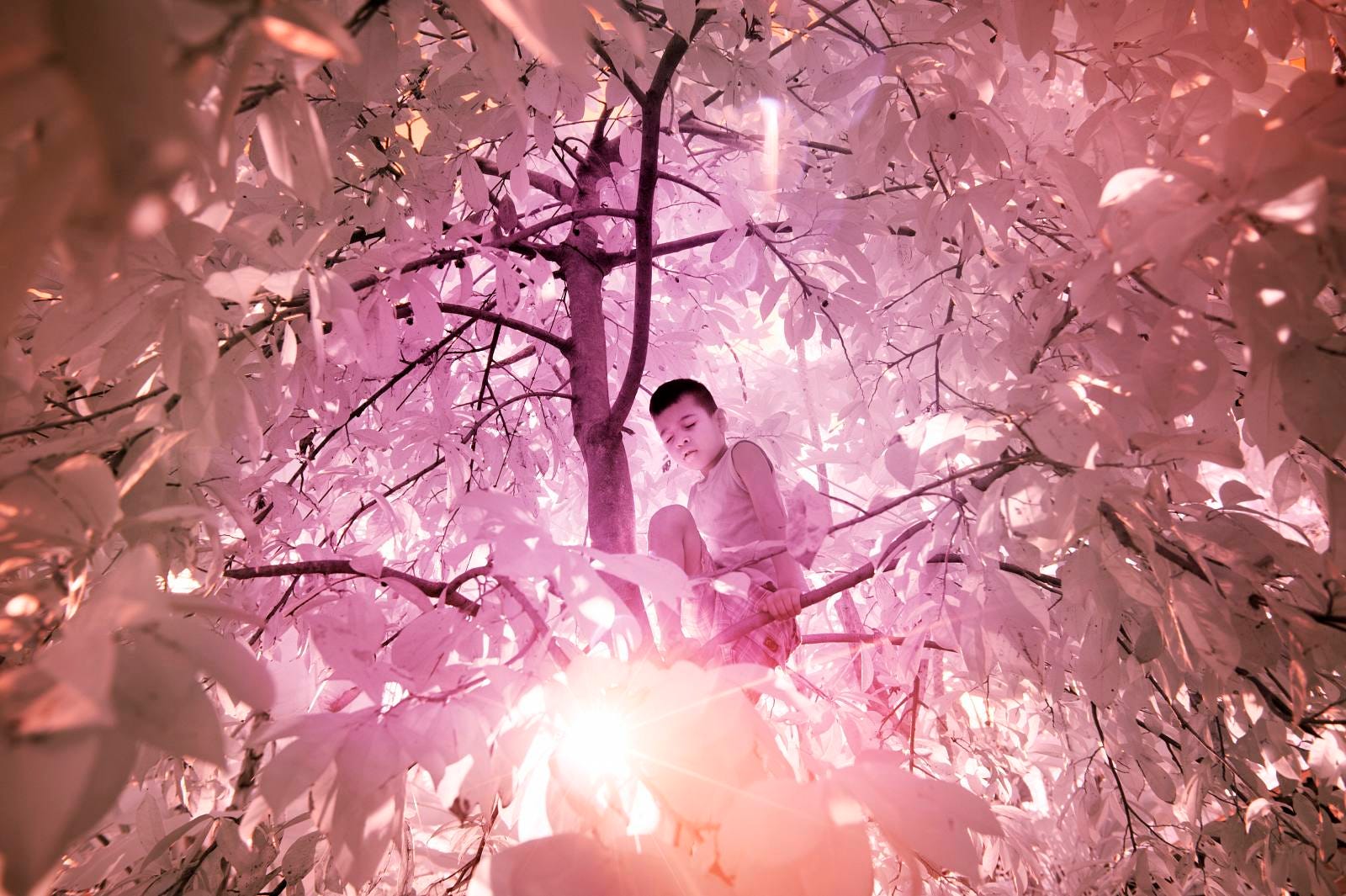
Infrared registers living foliage as pink, as red, as something the eye never granted it. On Pingelap and Pohnpei, Micronesian islands where a rare form of total colour-blindness runs through a large share of the population, she photographed in black and white and in infrared, and then had prints coloured by hand — by islanders who cannot see colour. The Island of the Colorblind came out in 2017.
Colour is the element most photographers pin down hardest and earliest: the grade, the palette, the reference frames pulled from a film. In that project it was determined by the chemistry of a film stock and by another person’s hand, neither of which could have been specified in advance.
Which returns to Nuti’s own formulation. She talks about showing iron as something fragile, or a leaf as something strong enough to hold a fence — no trick involved, simply a possibility already inside the material and ordinarily hidden. You cannot pre-visualise a possibility you have not yet been shown. Ingold’s argument is the same one, at a higher altitude: the form was in the flow, and you had to be inside the flow to meet it.
The leftovers
Nuti thinks constantly about leftovers — the offcuts, the discards, everything a process adds to a planet already sinking under its own matter. Part of what draws her to iron is that it leaves none. The material is worked in itself; nothing falls to the floor.
Your plans are leftovers. The deck, the board, the storyboard drawn to scale, the forty reference images: offcuts of a photograph that does not exist yet, produced before the fact and then made binding. The waste is invisible because it accumulates in advance rather than after.
So the scale model steals nothing. It is the first version of the sculpture, made in a material that cannot hold it, and it is where the piece actually got made. You reach the forge with what remains.
