

Surplus
The quality that separates a photograph which survives its caption from one that needs the reader’s ignorance to stay interesting.

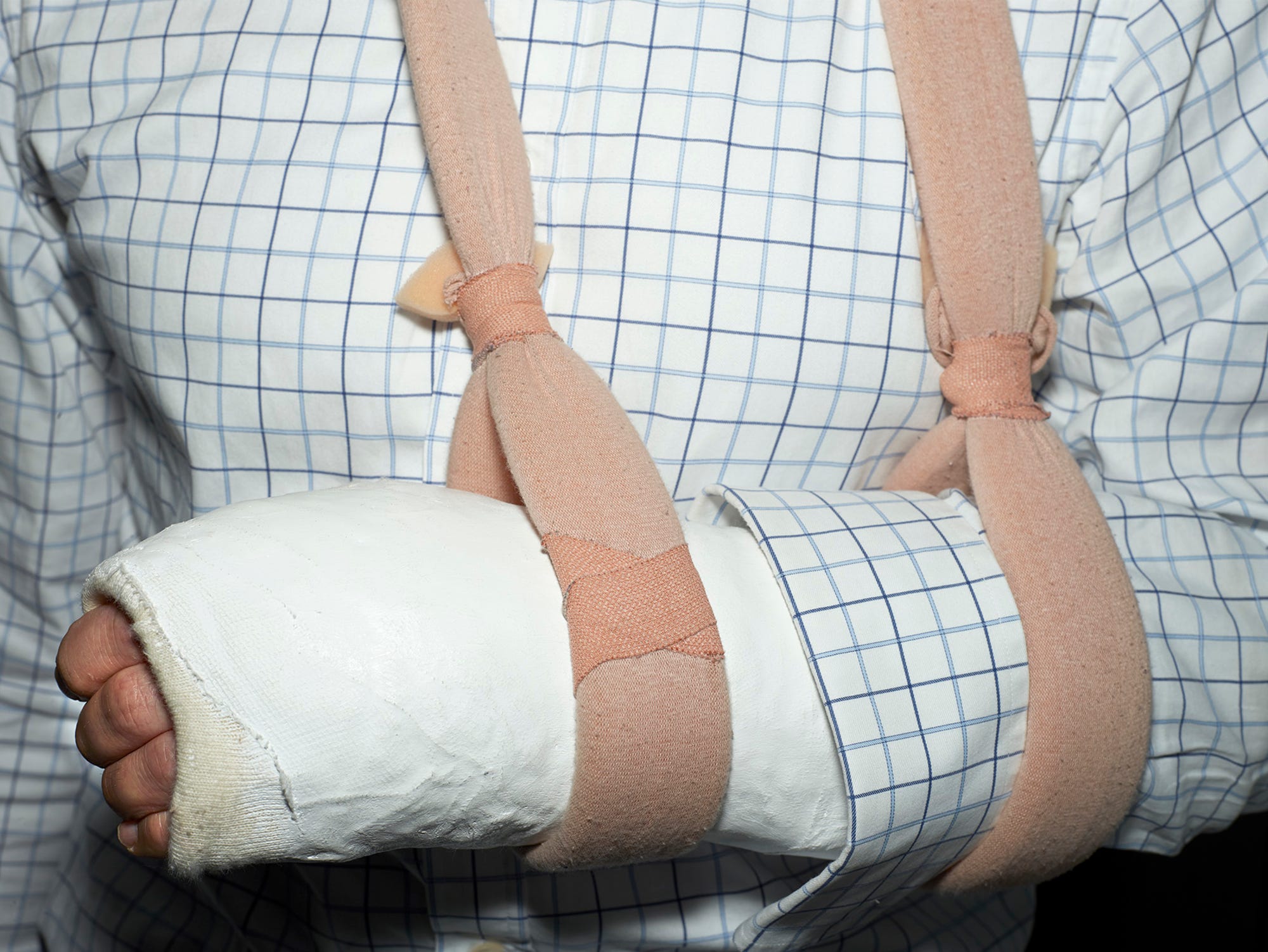
Somewhere in a shipyard or a plant — the picture will not say which — a man carries his arm in a plaster cast. The photographer has given the cast exactly the attention he would give a structural member: it hangs in its beige sling like a concrete beam in a hoist, and the sling reads as the cable holding it. The injury is not the subject. The engineering of the repair is.
That picture sits in FASHION, Mark Power’s 520-page collection of photographs made over twenty-seven years in twenty-three countries — construction sites, foundries, quarries, shipyards, recycling plants. It carries no caption. Neither does any other picture in the book. Power and his editor Stuart Smith ordered all 520 pages by colour, form and light alone: no dates, no places, no chronology.
Reviewers have treated the missing captions as the book’s central act. Strip the labels, the argument runs, and industry stops being Polish or Korean or Emirati and becomes one continuous process, everywhere at once. The subtraction is where the meaning arrives.
Give the credit somewhere else. The strangeness in FASHION was settled years before the edit, in front of the object, by a man who set up a slow camera and concluded this thing was worth the trouble. Removal cannot manufacture strangeness. It can only reveal whether strangeness was in the negative already. Which puts me against the standing orthodoxy of the contemporary photobook: that a pile of pictures becomes a work in the sequencing, that ambiguity is a decision you take at the light table.
What a caption cannot supply
A caption answers what, where and when. It has no way of answering the question a good industrial photograph raises, which is why anyone paid this much attention to a tarpaulin.
Surplus is the operative quality. Not mystery, not atmosphere — surplus: care spent on a thing well beyond what the thing appears to warrant. A large-format camera enforces it, because each exposure costs setup time, sheet film, and a public decision made in front of men who are waiting for you to finish so they can get back to work. Under those conditions you cannot photograph everything, so you must conclude on the spot that a coil of hose deserves the treatment usually reserved for a monument.
Picture the difference. A pair of work gloves has been left on a polished steel surface, fingers slightly curled, one cuff overlapping the other. A photographer in a hurry records them as a detail: hand-held, ambient light, three frames, move on. A photographer with surplus sets a tripod, waits for the overhead fluorescents to stop flickering against the steel, and holds the gloves dead centre with the symmetry you would give a pair of shoes in a Dutch still life. The second picture will survive being told exactly what it shows. The first will not, because it never contained anything the caption could fail to exhaust.
So run the test on your own work. Take the photograph you consider most mysterious, and write the caption a picture desk would demand — object, location, year, nothing else. Then look again. If the picture collapses into an ordinary record of an ordinary thing, its interest was living in your viewer’s ignorance, and you were the one keeping them ignorant. If it holds, and the plain sentence explains everything while settling nothing, the strangeness is structural. Only then does withholding the sentence become a defensible choice rather than a stage effect.
Evidence is the hard case
The strongest argument against all this is a book whose makers took none of the pictures in it.
Mike Mandel and Larry Sultan spent two and a half years inside the archives of seventy-seven corporations, government agencies and research bodies, looked at more than two million photographs, and kept fifty-nine. Every one had been made as a record — crime scenes, engineering tests, industrial trials — by staff photographers with no interest whatsoever in ambiguity. Published as Evidence in 1977 without a single caption, they turned obscure, funny and faintly sinister. The transformation happened in selection and order. Nowhere else.
The theory behind that transformation is respectable, too. Kendall Walton argued in 1970 that the qualities a work seems to have depend on the category you perceive it in: a feature counts as standard in one category and contra-standard in another, and the shift is perceptual rather than decorative. Read as a police record, a badly lit blur is equipment failure. Read as art, the same blur becomes a choice. Mandel and Sultan changed the category, and the pictures changed with it.
Yet look at the ratio. Two million photographs examined; fifty-nine kept. Two and a half years of driving to plants and sifting contact prints, with four hundred thousand images in a single sitting at one Los Angeles water authority. If recategorisation alone did the work, the mileage would make no sense — a few hundred pictures and a competent designer would have sufficed. The labour tells you what they were hunting: the rare frame where the care taken exceeded the purpose served. A wreck in the desert surveyed with the composure of a portrait. A routine test lit like an annunciation. Walton is right that the new category let those qualities register. He never claimed it put them there.
Both projects also needed somebody to talk their way in. Mandel and Sultan wrote to institutions on the letterhead of a mock company they had invented, Clatworthy Colorvues, with supporting letters from the National Endowment for the Arts. Power reached the Millennium Dome site in 1997 by citing a nineteenth-century convention: one photographer follows a great public build from first excavation to opening day. Access buys the only thing surplus attention actually requires, which is time.
Two architects recommend gravel
In 1996 the city of Bordeaux commissioned Anne Lacaton and Jean-Philippe Vassal to embellish Place Léon Aucoc, a small triangular square of gravel and lime trees near the rail yards. They spent months there. They watched the pétanque, talked to the people on the benches, learned how the square was used across a day and across a season. Then they submitted their proposal: replace the gravel, clean more often, look after the trees. Nothing else. The city, baffled, at first refused it.
Read as modesty, the story is charming and useless. Read as diagnosis, it is the whole argument. Anyone can propose to leave a thing alone; only someone who has watched it for months can propose it and be right. Lacaton has been firm ever since that the square was a commission and leaving it untouched was a decision, not a failure to make one.
Removing your captions is the same manoeuvre and carries the same risk. It costs nothing at the moment you do it. It is defensible only if the years of looking behind it have already made it true.
Test it on someone who does not know you
The failure I see most often in this kind of work is not vagueness. It is privacy.
A photographer assembles a personal project — a house, an illness, the town they left — presents it without captions, and mistakes confusion for depth. The pictures lean on a story only the maker knows. Deprived of the story, they do not turn strange. They turn blank. Nothing has been withheld from the viewer, because nothing was there to withhold.
Test for it deliberately, and test badly on purpose. Show the sequence to someone with no knowledge of the project, and ask a flat, unhelpful question: what is happening in this one? Not what they feel. What they see. If they describe the objects accurately and the sequence still unsettles them, the oddness lives in the pictures and your missing captions are doing honest work. If they cannot describe the objects at all, you have made fog rather than ambiguity — and the distinction is worth holding onto, because fog is uniform. Every fogged picture is odd in the same way. A genuinely strange photograph is odd in one specific way you could name under pressure, if you had to.
None of which makes sequencing trivial. Order governs pace, attention, how long a reader stays on a spread and what they carry to the next one. Power's edit took years — over three days at a Magnum Live Lab in Lisbon in late 2018, he and Smith cut four thousand pictures down to under two hundred, and the book appeared in 2025 — and that patience shows in every pairing. Two photographs set side by side can produce a third thing neither holds alone; Power has said as much himself. What no arrangement can do is put surplus into a frame that was made without it.
Return to the man with the plaster cast. Nothing in that photograph depends on your not knowing where it was taken. Supply the country, the year, the name of the yard and the machine responsible, and the sling still reads as a suspension cable, the limb inside it still reads as load. The information would sit alongside the picture without touching it.
A book with no captions is therefore not a veil the designer draped over the work. It is a verdict the photographer passed on his own negatives years earlier, in the noise, with a slow camera, when he decided this thing deserved the good light. Readers are entitled to check the verdict. Most books that make it are bluffing.
