

Nine Vanishing Points
David Hockney's lifelong quarrel with the camera — and his case for why a small lane in Yorkshire can rival the Grand Canyon.

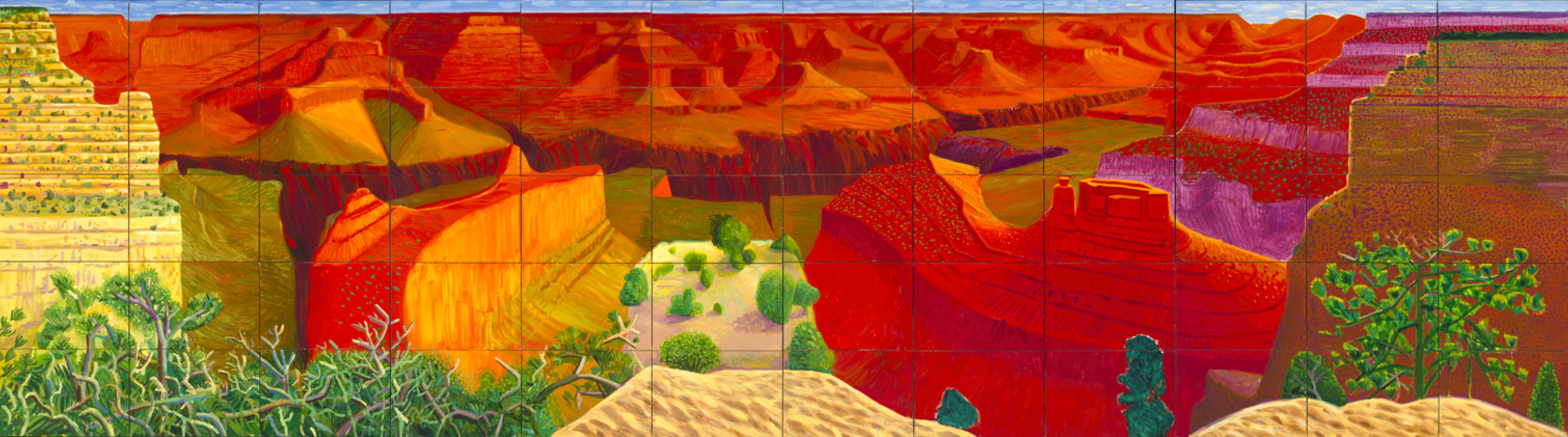
Most people don’t look. They scan the ground ahead, dodge obstacles, and move on. David Hockney has spent over sixty years doing the opposite — and his career proves why it matters.
In interviews across several decades, the British painter, draughtsman, and relentless experimenter returns again and again to a handful of convictions. They’re simple enough to fit on a cigarette packet. Yet they carry more practical wisdom for any artist or photographer than a shelf full of technique manuals.
Here’s the core of it: look with intensity, embrace new tools without fear, give yourself enormous tasks, and stay so excited about your work it keeps you alive. These aren’t soft platitudes. Hockney has put them into practice at every stage of his career, from photo collages of the Grand Canyon to iPad sunrise drawings made from his bed in East Yorkshire.
If you want to build a creative life with real staying power, pay attention.
See what others miss
Hockney tells a story about a philosopher on television. Asked how anyone can remain optimistic given the state of the news, the philosopher replied: the arrival of spring. Good news nobody notices.
This is the foundation of Hockney’s entire practice. He looks at a small lane in the Yorkshire Wolds — a road most drivers would pass without a second thought — and finds something as spectacular as the Grand Canyon. His doctor, an amateur painter, admitted she had never truly looked at the street near her own home until Hockney’s paintings and films forced her to see it. She went back and took a long walk. The work changed how she moved through her own neighbourhood.
For you, the lesson is direct. Wherever you are, there is a subject worth your full attention. The problem is almost never a lack of interesting things to photograph or paint. The problem is a lack of concentrated attention. Start with what is closest. Your street. Your window. The view from your bed at sunrise.
Carry a sketchbook or your phone and commit to one observational drawing or photograph every day for a month. Not a good one. Just an honest one. The quality of your attention will sharpen faster than you expect.
Use every tool — but know its limits
Hockney has worked in oil, acrylic, watercolour, crayon, fax machines, photocopiers, Polaroid collages, multi-camera video rigs, and the iPad. He is not a technologist. He is an artist who refuses to let any medium become a prison.
When he tried to photograph the Grand Canyon with collaged Polaroids and printed them large for a museum in Cologne, he hated the result. The space vanished. The photograph flattened everything into wallpaper. So he went back, sat on the rim for a week, drew, looked, and then painted. The pigment did what the camera could not — it gave the viewer a sense of standing at the edge.
His criticism of photography is worth understanding, because it goes beyond personal taste. Hockney argues a conventional photograph locks you into a single vanishing point — one lens, one moment, one fixed perspective. Your eye, by contrast, never sits still. Stand at the rim of the Grand Canyon and you do this: you look down, you look left, you look across, you tilt your head. You scan constantly. Each glance carries its own focal point, its own sense of depth. Over time, your brain stitches these fragments into something a single shutter click cannot replicate: a felt experience of space.
This is exactly why Hockney built his nine-camera rig. Each camera points in a slightly different direction, with its own vanishing point. When the footage plays on nine screens, the viewer is forced to scan — just as the eye scans a real landscape. The result is closer to how we actually perceive the physical environment: through movement, through time, through accumulated glances rather than a frozen instant.
Even the IMAX cinema at the Grand Canyon, he points out, tells you where to look. His nine cameras do the opposite. “Ninety is about three times better than 3D,” he jokes — but the principle beneath the humour is serious.
A conventional photograph fixes a single vanishing point; your eye shifts between dozens. The lens distributes focus uniformly across the frame; your gaze is selective, drawn by interest and instinct. A shutter freezes an instant; perception unfolds over lived time, built from accumulated glances. The camera observes from a distance; the body absorbs from within. And where film struggles with subtle gradations — greens especially — the human hand can exaggerate just enough to convey what the eye actually felt.
The practical point? Learn what your tools can and cannot do. Photoshop, Hockney observes, has made magazines look stale — every image polished to the same sheen, blemishes removed, highlights added. The result is visual monotony. If you rely on a single tool or a single process, your work will start to resemble everyone else’s.
Try this: pick a subject and render it in three different media within a week. Photograph it, draw it, paint it. Notice what each method reveals and what it conceals. The gaps between them are where your own creative voice can emerge.
The hand, the eye, and the heart
“The Chinese say you need three things for a painting: the hand, the eye, and the heart. Two won’t do.” — David Hockney
Hockney returns to this idea often, and it deserves more than a passing mention. It is, in many ways, the philosophical spine of his entire practice.
The hand is craft — the physical ability to make marks, to translate perception into material form. The eye is observation — the trained, attentive gaze he has spent a lifetime refining. The heart is the part most easily neglected: emotional investment, genuine care, the reason you picked this subject and not another.
Hockney stood in front of a Picasso ceramic owl and explained to a young companion why it was more thrilling than a taxidermied owl in a museum case. The stuffed owl is an owl. Picasso’s owl is an account of a human being confronted by an owl. There is more “owlness” in the ceramic, he says, because it carries the mark of all three: the hand shaped it, the eye observed it, and the heart responded to it.
Much contemporary work, Hockney implies, leans on only two of the three. Clever concept and skilled execution, but no genuine feeling. Or raw emotion and sharp observation, but no craft to carry it. The trinity must be complete.
Ask yourself, honestly, which of the three you tend to neglect. Then do something about it. If your hand is weak, draw every day. If your eye has gone lazy, sit somewhere for an hour and just look. If your heart has drifted from the work, go back to the subject you first loved and remember why.
Give yourself a task too big to finish easily
In his early seventies, Hockney signed a ten-year lease on an enormous studio in Bridlington. The moment he signed, he felt twenty years younger. He then set himself to document the arrival of spring across the Yorkshire landscape — dozens of large-format iPad drawings and paintings of the same locations as they changed from winter through mid-June.
This was not a casual project. He calculated around seventy large pieces arranged around a room so a viewer could watch spring emerge, like a Chinese scroll unfolding as you walk. He needed the winter pictures to make the spring ones meaningful. He needed the scale of the studio to print them big enough to reveal their power.
Monet did the same. Hockney loves to remind people the French painter didn’t begin his great water lily series until his seventies. “Things like that give you energy,” Hockney says. The task itself becomes a source of vitality.
The French have a phrase for it: joie de vivre. Hockney puts it bluntly: its absence is a killer.
So give yourself a project large enough to scare you a little. A year-long series. A body of work built around a single place across all four seasons. A self-imposed deadline tied to an exhibition or portfolio review. The scale of the ambition will pull energy from somewhere you didn’t know you had.
Accept loss as a creative advantage
Hockney lost much of his hearing over the years. Rather than treat it purely as a deficit, he noticed something remarkable: his ability to perceive space through his eyes became sharper. With sound flattened, he began to locate himself more intensely through vision. “I wouldn’t know it had been heightened unless I used that professionally, as I do, as an artist,” he says.
This is not toxic positivity. It is a practical observation about compensation and adaptation. When one faculty diminishes, others can strengthen — but only if you pay attention and use them deliberately.
Every artist faces constraint. Limited budgets, limited time, limited access to studios or locations, limited physical ability. The question is whether you treat the constraint as a wall or a redirection. Hockney’s hearing loss didn’t make him a worse artist. It changed how he experienced space, and space had always been at the centre of his work.
If you’re working with limitations right now — and you are, because everyone is — ask yourself what those limitations might be teaching you to see or do differently.
The long view
Picasso smoked and lived to ninety-one. Monet smoked and lasted to eighty-six. Hockney’s explanation has nothing to do with tobacco and everything to do with creative absorption. When you are genuinely excited by your work, you get out of yourself. He considers this a form of health no doctor can measure — and no government health notice will ever advertise.
And Hockney, now in his late eighties, is still proving the point. He hasn’t retreated into the comfort of oil paint and canvas — techniques he mastered decades ago. He is still working on the iPad, still pushing at the edges of what a screen and a stylus can do. His recent work from Normandy, produced entirely on the tablet, shows an artist whose curiosity hasn’t dimmed with age. It has sharpened.
This is the real lesson of creative vitality. It has nothing to do with staying young. It has everything to do with staying technologically curious, emotionally open, and willing to be a beginner again. Hockney isn’t painting like it’s 1960. He’s painting like it’s 2026. And he’s having a wonderful time.
Stay curious, stay practical
One of Hockney’s most endearing qualities is his pragmatism. He painted the Grand Canyon on multiple small canvases joined together — partly because it solved a compositional problem, and partly because a single enormous canvas is a nightmare to transport. He used six canvases for outdoor landscape paintings because the staircase in his original studio was too narrow for anything bigger. When he couldn’t get the spring on film with nine cameras, he drew it instead.
Great artists solve problems. They don’t wait for perfect conditions. They work with what they have, where they are, and they figure out the rest as they go.
The same practical intelligence shows up in Hockney’s approach to art history. He spent years studying how Old Masters used optical devices — lenses and cameras — and published his findings. Knowledge, he argues, can be lost. The library at Alexandria burned. Millions of photographs rot in salt mines. Techniques known to seventeenth-century painters were forgotten for centuries. The lesson? Document what you learn. Share it. Don’t assume the knowledge you gain will survive on its own.
For you, this means: keep notes on your process. Write about what works and what doesn’t. Teach someone else what you’ve figured out. The act of articulating your method will clarify it for you — and it might survive long enough to help someone you’ll never meet.
The real measure
Hockney thinks we live in a dreary age obsessed with measurement. “You can’t measure loads of things,” he says. “They’re not measurable.” The energy you get from a Monet exhibition, the excitement of a ten-year studio lease, the way a small lane in East Yorkshire can hold as much wonder as the Grand Canyon — none of these fit neatly into a spreadsheet.
Your creative life will resist measurement too. The number of followers, the gallery placements, the likes on a post — none of these capture what matters most, which is the quality of your attention and the depth of your commitment to the work.
Look harder. Use every tool at your disposal. Give yourself tasks big enough to keep you awake at night. Stay practical. Stay curious. And if a policeman ever tells you death is lurking everywhere, remember what Hockney said, gazing at the first leaves of spring: “Well, life is lurking everywhere as well.”
Keep looking. The spring is coming.
