

Load-Bearing
Exposed process has hardened into a manner, so it needs a test: remove the rope, the cut edge, the visible rig, and see whether the picture still says anything.

A truck parked at the edge of a palm grove in southern Spain, at night. Inside it, a wide-format printer of the sort that normally lives in a studio in Paris. A trestle table among the trees, lights rigged around the clearing, and a camera on a tripod weighted down so it cannot shift by a millimetre — because everything that follows depends on it not moving.
The team photographs the grove. The file goes to the computer, comes out of the printer at close to life size, gets cut into vertical strips, and the strips are clipped to a wooden armature standing between the camera and the trees. The final image is part grove and part paper. You can see where the strips end.
Those visible cuts are the argument of the picture, not a blemish on it. This is Noémie Goudal’s Phoenix, and it runs directly against the doctrine most of us absorbed early: that craft means the concealment of craft, that a paper edge or a tripod leg in shot is a failure of execution, that the manufacture of an image is backstage business the viewer should never catch. That doctrine is wrong often enough to be worth abandoning deliberately. A picture that hides how it was made can only ask you to believe it. A picture that shows its own construction can make a claim about how images and evidence work — and can make it inside the frame, without a caption.
The lightning is in a laboratory
Marina Gadonneix takes photographs of lightning, avalanches and aurorae, and she does not go to where those things happen. She goes to research laboratories in Europe and the United States where scientists reproduce them, and photographs the reproduction — the rig, the floor, the cabling, the strange coloured event in a room built to contain it. The pictures in Phénomènes look at first like abstraction. Then you notice the wall behind.
Refusing the real avalanche in favour of the simulated one sounds perverse until you follow the logic. The scientific image of a phenomenon was never a recording of the thing; it was always a recording of an apparatus built to make the thing appear under controllable conditions.
Gaston Bachelard gave this a name in 1934. He argued that modern science does not observe phenomena so much as produce them, and that instruments are theories in material form — phénoménotechnique. A cloud chamber does not show you a particle. It shows you what a particle does to a cloud chamber. Since photography is an instrument in exactly this sense, every photograph is partly a photograph of its own conditions, and the only real question is whether those conditions appear in the picture or are edited out of it.
The mannerism problem
The objection to all this is strong, and if you have spent any time around contemporary art photography you have already made it. Visible process has become a manner. Anyone can leave a rope in shot. Anyone can let the edge of a backdrop show and then write a statement about the constructed nature of the image, and the gesture will read as rigorous whether or not anything rigorous took place. Worse, it functions as insurance: nobody can accuse you of faking a landscape if you have pre-emptively confessed. A badge of process is not a thought.
All of that is true, and a great deal of exposed-apparatus work deserves the suspicion. So the seam needs a test, and the test is whether the picture fails without it.
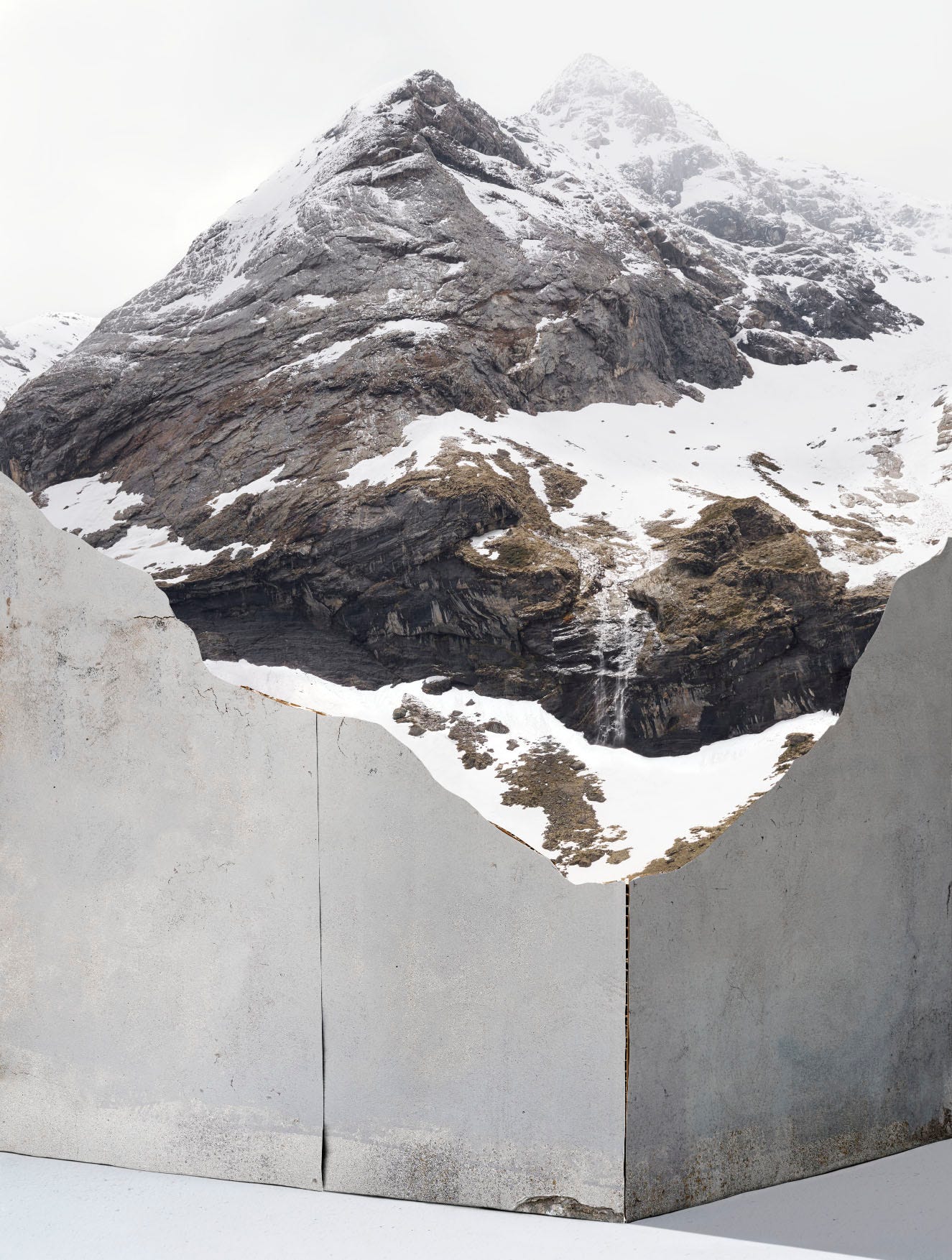
Try it on the palm grove. Remove the cut edges — clean the joins in post, let the printed strips fuse into the real trees — and you have an attractive photograph of a jungle. Nothing survives. Leave them, and the image tells you that a person stood in this grove for one night with a printer and a knife, and reassembled the place out of a picture of itself taken four hours earlier. That is a statement about how landscape and representation fold into each other, and it is legible only because of a visible line. Goudal has been consistent about this for years; in Mountain III she cut shapes of cardboard, set them against a snow-topped range, and left the cut edges showing rather than trim them into the horizon.
By that test, most decorative process-revealing collapses immediately. The rope earns its place or it does not. Ask of every element you were about to remove: does the viewer need it to reconstruct what happened here? Keep what carries the sequence of actions. Cut what merely advertises that you were clever.
Withhold the where
Something less discussed sits alongside this, and it is the sharper lesson. Goudal shows you exactly how the image was built and refuses to tell you where it is. She builds her backdrops from an archive of pictures taken in many countries, deliberately mixing them, so the finished place exists nowhere. The Phoenix grove was in Spain. She has said plainly that the location carries no meaning for the work.
That inverts the standard arrangement. Documentary practice sells the where and buries the how: a caption fixes the place and the date, while the choices of lens, distance, waiting and exclusion stay invisible. Goudal trades one for the other, and gains something specific. A palm belongs to a tropical band running right around the planet, so a grove that could be in Spain or Brazil or Senegal stops being a destination and becomes a climate — a condition that has moved across the earth’s surface over millions of years, and will move again.
Here is where the principle becomes usable. Take a picture you have made and work out which question a stranger asks first: where is this, who is that, when was this, is this real? That question is what your image is actually about, whatever you intended. Then decide whether you want it asked at all — and if you do not, find the single element that provokes it and take it out. Not soften: remove. The road sign, the number plate, the recognisable skyline, the caption you were going to write. What remains has to hold attention without the crutch of location, and most work cannot, which is precisely the information you wanted.
Carson kept the staples
In 1969 Alvin Lucier recorded himself reading a short text into a microphone in a room. The text described what he was about to do: play the recording back into the room, record that, play it back again, and repeat until the room’s own frequencies overwhelmed his voice and the words came apart. Then he did it. Forty minutes later the speech has dissolved into tones that belong to that room and no other. The description and the piece are the same object. Nothing is concealed, and the concealment of nothing is what makes the work legible as an experiment rather than a mood.
Anne Carson’s Nox works the other way round and arrives at the same place. After her brother died she made an epitaph by hand, pasting letters, photographs and scraps into a notebook. The published version is a photographic facsimile of that object, accordion-folded in a box: the tape shows, the staples show, the photocopies are blurred where the originals were creased. On the box she describes it as a replica, as close as they could get. A cleanly typeset Nox would have been a smaller book, because the grief in it is carried by the physical evidence of a hand at work in a bad year, and typography would have deleted exactly that.
Both cases point the same way. What looks like unfinished surface is doing the load-bearing work, and the polish you would apply to protect the object would remove its argument.
Go back to the grove. Behind the paper, the actual trees stand in ground whose history runs to tens of millions of years, and they give no sign of it — a photograph of them alone would be undatable, a postcard from any decade. In front of them hangs a printed strip four hours old, its cut edge catching the light. The join between the two is the only element in the entire frame that admits to having happened at a particular moment. Everything else in the picture is available for belief. The seam is the one part that tells the truth about time, which is why finishing it away would have cost the picture its subject.
