

Go Behind the Station
What a generation of photographers — from Martin Parr to Barbara Kasten — keep telling young artists about failure, obsession, and the slow accumulation of a creative life.

You already know what to do. You’ve known for a while. The camera is right there, the light is decent enough, and the street outside has been full of stories since this morning. So why are you still reading about it instead of doing it?
Paul Graham — the British photographer whose A Shimmer of Possibility turned the banality of everyday life into something luminous — has a blunt answer: start. Make mistakes. Produce work so bad it embarrasses you. Then do it again tomorrow. Every new project he undertakes begins with junk, he admits. If the man who made quiet suburban afternoons feel like revelations can sit with early failure, so can you.
This urge to wait until you feel ready, until you’ve watched enough masterclasses or saved up for a better lens, is one of the quietest traps in creative life. Elina Brotherus puts it plainly: young people tend to think too much and work too little. The secret, she says, is to go out, take pictures, then look at them. The photographs themselves will tell you where to go next. Your own work becomes your most honest teacher — but only if you produce enough of it.
The Myth of the Perfect Moment
Here’s something Martin Parr has admitted freely: he has far more bad pictures than good ones. Every time he steps out with a camera, he hopes for a great photograph. Most days end in disappointment. Yet he keeps himself ready, because the good picture might arrive at any moment — and you have to be present for it.
Think about what this actually means in practice. Imagine a contact sheet with thirty-six frames. One works. Maybe. The other thirty-five are learning, refining, circling. Now multiply those contact sheets across weeks, months, years. Alex Webb’s dense, layered colour photographs from Haiti, Mexico, and Istanbul didn’t come from brief visits; they emerged from years of repeated returns to the same places. Behind every published image of his sits a vast, silent archive of pictures nobody will ever see — frames where the geometry didn’t lock, the colour fell flat, or the moment passed a half-second too early. The visible work is the tip; the mass of submerged effort beneath it is what holds it up.
Once you internalise this ratio — one keeper for every hundred attempts, sometimes fewer — something shifts. You stop expecting every frame to be extraordinary, and you give yourself room to experiment, to wander, to stumble onto something you couldn’t have planned.
What the Photograph Needs from You
Anton Corbijn once described the balance a strong photograph requires: something of the subject, something of the photographer, and something new — something never seen before. The camera is the same in everyone’s hands. What differs is the person behind it and the willingness to push beyond what already exists.
This idea of “something new” lands differently when you consider it alongside presence. Collier Schorr has pointed out a quiet paradox of the medium: photographers talk about power and control — you own the picture, you frame the scene — but your life as a photographer is fundamentally about what stands in front of you. You point outward. You rarely see yourself reflected. So the “something of the photographer” Corbijn describes can’t come from self-obsession. It has to come from the quality of your attention, the particular way you notice what others walk past.
Nan Goldin takes this further. The most important skill, she insists, is to stand before another person and feel genuine empathy for them. No screen can replicate the quality of attention required. If you want your portraits to carry emotional truth, you earn it through real human connection — face to face, breath to breath. Corbijn’s “something new” often emerges precisely here, in that unrepeatable exchange between two people who are fully present with each other.
Put the Phone Down
Goldin’s warning carries the weight of someone who documented an entire generation’s most intimate moments long before anyone had a smartphone. Don’t mistake your phone for your life, she says. You have far more to say than Instagram allows, and far more to experience in the physical presence of other people.
This isn’t a nostalgic plea for film cameras and darkrooms. It’s a practical observation about creative depth. When your primary relationship with images happens through a four-inch screen, your sense of scale, texture, and emotional resonance shrinks to fit.
Try a simple experiment. Step away from the feed for a week. Print some of your work. Pin it to a wall. Look at it from across the room. Notice how differently your eyes respond to a physical image versus a thumbnail. This small act can reset your entire creative compass.
Feed Your Curiosity Beyond the Lens
Ishiuchi Miyako makes a claim worth repeating: if you take photographs, the camera alone is not enough. You need literature. You need music. You need cinema. Photography is one part of a larger cultural whole, and the richness of your images will reflect the richness — or poverty — of everything else you consume.
Ulay, the performance artist, pushed this idea into more radical territory. His advice to young artists was to skip the art academy entirely and stay away from galleries. These are ready-made experiences, he argued — pre-digested culture. If you want genuine inspiration, go behind the central station.
Why the train station? Because that’s where the city stops performing. Behind the polished façade of any terminus you’ll find loading docks, stained concrete, people sleeping rough, pigeons fighting over bread crusts, the smell of diesel and rain on warm tarmac. Life there hasn’t been framed, curated, or lit for anyone’s benefit. The textures are raw: peeling posters layered over older posters, a plastic bag caught on a fence, someone laughing too loudly into a phone. A gallery gives you someone else’s finished interpretation of the world. The back of the train station gives you the unprocessed material from which your own interpretation can grow.
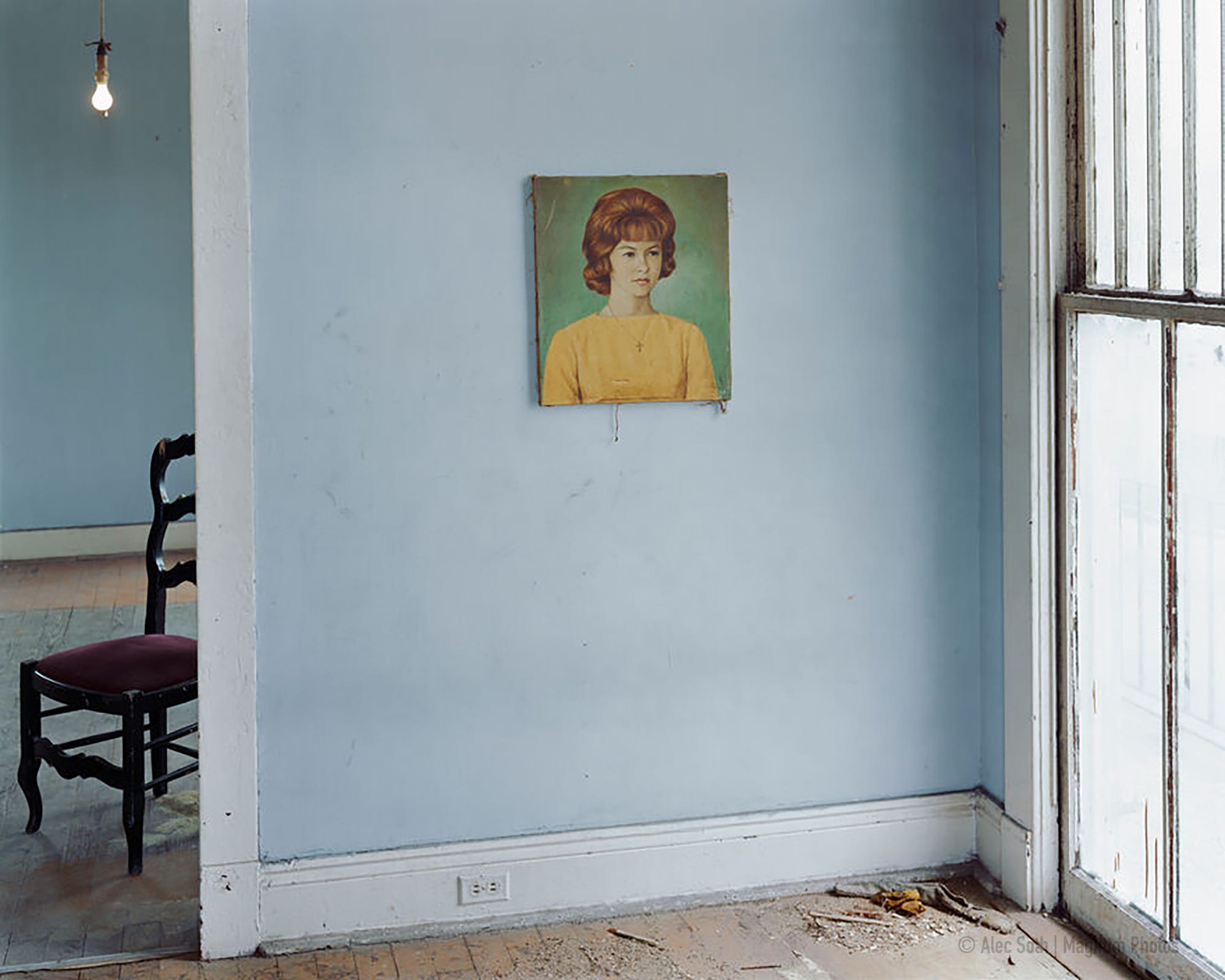
Alec Soth’s work proves the point. His Sleeping by the Mississippi reads like a novel in pictures, informed as much by poetry and American literature as by photographic tradition. Soth didn’t become distinctive by studying photography alone. He became one by reading, listening, and paying attention to the texture of ordinary life.
Practical steps: pick up a novel this month with no connection to your usual interests. Watch a documentary about a subject you know nothing about. Attend a concert for a genre of music you’ve never tried. These aren’t distractions from your photography — they’re fuel for it.
Obsession, Patience, and the Long Game
A creative practice sustained over years requires something beyond enthusiasm. Martin Parr puts it with characteristic bluntness: unless you have an almost disease-like obsession with photography, you probably won’t earn a living from it. The question isn’t whether you have talent. Talent is common. The question is whether you have the kind of compulsive need to make pictures even when nobody is paying you, even when nobody is watching, even when the results disappoint you week after week.
This obsession demands a different relationship with time. Consider what it means to spend years in a darkroom — a monastery of silver and chemical light — where hours vanish in the service of a single image and the outside world falls away. Ishiuchi Miyako lived this, and says so with almost impatient directness: endeavour is fundamental, and it shouldn’t even be necessary to point it out. Or consider Barbara Kasten, who waited until she was eighty to receive the recognition her work deserved. Eighty. The common thread is a willingness to let the work accumulate on its own terms, without forcing it toward a deadline or a career milestone. Think about the future of your practice, yes — but don’t let the future become the point. If recognition comes, it comes. The perseverance itself is worth it.
There is, however, a subtler trap on the other side. Stephen Shore has watched it close around his students for forty years: early success becomes a cage. A project lands well, a gallery takes notice, and suddenly the artist refuses to abandon the style or subject matter responsible for the attention. Growth stalls. The courage to leave behind what works, to risk confusion and uncertainty again, separates the artists who keep evolving from the ones who repeat themselves. Shore’s own quiet confidence — rooted so firmly he can absorb even terrible reviews without flinching — comes not from stubbornness but from an ongoing willingness to move forward into unfamiliar territory.
Your Move
Put this article down. Pick up your camera — or your pencil, or your instrument, or whatever tool answers the creative itch. Go outside. Make something bad. Then make something slightly less bad. Keep a notebook of everything you notice: the colour of rust on a railing, a stranger’s grip on a coffee cup, the way afternoon light cuts a diagonal across a concrete wall.
Don’t wait for permission. Don’t wait for the perfect project idea. Don’t wait for a grant, a gallery, or a follower count.
Graham describes a beautiful phenomenon. Sooner or later, if you keep working, the world will lean in close and whisper: let me show you something far more interesting than your little idea. Let me show you a much better way of seeing. But you have to be out there — present, attentive, and ready to listen.
Start today. The rest will follow.
