

Found
Sim Chi Yin spent four years inside a dying man's life before it became a project. That gap between living and making may be the point.

The photographs that changed how you see were almost certainly made by someone under instruction.
Timothy O’Sullivan surveyed the American West for geological expeditions. Dorothea Lange and Walker Evans worked under a government brief. None of them set out on those mornings to make art. They set out to document — and the transformative images arrived anyway, not despite the constraint but, in some fundamental sense, through it.
This is not a paradox to explain away. It is a clue about how photography actually works — and it implies something that cuts against most advice about building a serious practice: that the pursuit of pure artistic autonomy may be exactly the wrong strategy for this particular medium.
The Invisible Hand
In painting, the maker’s presence is inseparable from the object. You can read Morandi’s sensibility in every centimetre of his canvas — his hesitations, the particular grey he mixed for that shadow, the way his attention lingers in the corners. The evidence of making is literally the work. But a photograph carries no such trace. No surface, no gesture, no record of revision. The photographer’s hand is invisible in the image.
This is typically framed as photography’s limitation: the reason certain gallery contexts still receive it with suspicion, the reason it struggles to command the critical language the other visual arts take for granted. But think what it actually implies for practice: because there is no visible mark to carry meaning, the image must carry it through what was there — through the world’s offer to the camera at a particular moment. The medium is structurally receptive. It records rather than constructs. The photographer’s central competence is not imposition but readiness: being in position when something real presents itself, with the craft to hold it steady.
Henri Bergson, in An Introduction to Metaphysics, drew a precise line between analysis and intuition. Analysis always works from the outside: it breaks its subject into parts, translates it into symbols, and tries to reconstruct the whole from accumulated fragments. But the reconstruction never equals the original. Translate a poem into every language available and sum the results — you will not recover the poem's inner meaning, because that meaning was inseparable from its original form, and analysis took you away from it the moment it began. Intuition, by contrast, enters into the thing and coincides with what is unique and inexpressible in it. The photographer pressing the shutter on an instinct they cannot yet name is not acting on incomplete information. They are acting on a different kind of information entirely — one that analysis would only destroy by the time it finished. Photography runs on this faculty more heavily than almost any other visual discipline, because the window in which you can act is almost always too short for analysis to complete itself.
Take on work with an external brief — a portrait series for a local publication, documentation for an organisation whose purpose you respect. Shoot it with the full attention you’d give a personal project. Commission work strips away the indefinite second-guessing that total freedom permits, and what remains is a cleaner signal of what you actually see.
When Images Become Arguments
Sometime in the 1970s, photographs began to be worth real money, and the question of whether photography was Art moved from the margins into the institutional centre. With it came a new pressure: photographs needed to be legible. They needed ideas that could be written about, concepts clear enough to justify a wall text, positions a curator could defend in print.
Some of the work that emerged from this moment is genuinely remarkable. But much of it is laboured in ways that betray the medium. You can feel the photographer reaching for significance rather than receiving it. The images look like arguments — precise, premeditated, finished. They have been constructed rather than encountered.
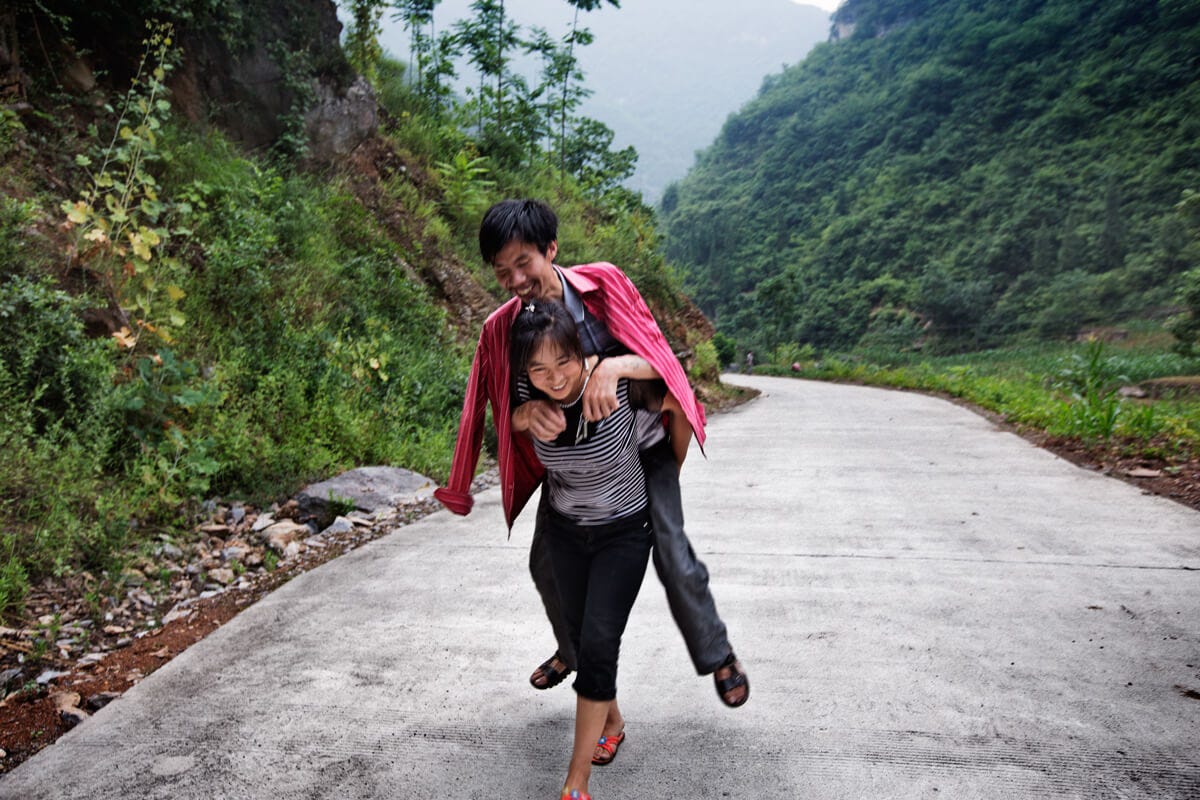
Alejandro Cegarra's project The Two Walls — seven years of photographs following migrants across Mexico toward the US border — began the year after he himself migrated from Venezuela to Mexico in 2017. He didn't arrive at the subject from outside with a visual concept to test. He was already inside the situation: sharing the language, the displacement, the specific knowledge of what it costs to leave. When he began photographing migrant caravans in 2018, he wasn't illustrating a thesis about borders or policy. He was attending, with a camera, to people whose circumstances he recognised. The images that accumulated over those years — the couple who fell in love on a freight train, the child held in her mother's arms at a border fence — are not effects he applied to the situation. They are what the situation offered back to someone present enough to receive it. No brief could have produced them, because they required the photographer to be subject to something rather than above it.
Look at your last twenty images from a self-directed project and ask honestly whether you were confirming or discovering. If they feel like evidence for an argument you’d already reached before you started, the project is confirming rather than discovering. Try imposing a single external constraint — a subject you didn’t choose, a location outside your usual ground, a hard time limit — and see whether the images open up.
The Cost of Explanation
The pressure to articulate your practice is relentless, and not without value. Artist statements, portfolio reviews, grant applications: they force a kind of accountability that can genuinely clarify thinking. But there is a point past which articulation damages what it describes.
Maurice Merleau-Ponty’s account of embodied perception offers a precise caution here. Pre-reflective bodily knowledge underlies skilled action, and conscious analysis tends to interrupt the very thing it tries to observe. When you pay deliberate attention to each component of a movement you normally perform automatically — each step on a staircase, each adjustment of balance — the coordination breaks down. The scrutiny disrupts what it examines. Something parallel happens to photographic instinct. Theorise your process too precisely and you risk converting a living practice into a procedure — something you follow rather than something you do.
The photographs that surprise you — where you look at the contact sheet and don’t entirely recognise the reasoning behind the image — are often your strongest. That gap between intention and result is not a problem to resolve. It is evidence that the instinct reached somewhere your conscious plan didn’t, which is exactly the point.
Write your artist statement after a body of work is complete, not before. A statement written in advance tends to become a cage. You end up making images that confirm what you already declared, which is the opposite of what this medium does well. Write it last, in retrospect, treating it as an attempt to describe what happened rather than predict what will.
Two Tracks, One Inquiry
The photographers who have handled this productively tend to keep two things running simultaneously: externally motivated work alongside personal projects, each informing the other rather than competing.
Sim Chi Yin spent four years documenting Chinese gold miners dying of silicosis in the mountains of Shaanxi — work that became Dying to Breathe — while continuing to take journalism assignments for international publications throughout. The discipline of those assignments required her to test her questions against specific people, specific evidence, specific consequences. The personal project gave those questions a frame too large for any single commission. Neither track produced the same work without the other. The constraint of one sharpened the ambition of the other.
This is not the same as treating commissioned work as what you do to fund your real work. That framing creates a hierarchy that quietly degrades both tracks. Treat all serious work as part of one ongoing inquiry — different registers of the same attention — and the hierarchy dissolves. The commission stops being a compromise and becomes a test.
When a brief pulls against your current personal project, take it anyway, at least once. Notice what skills transfer across the two contexts and what assumptions the unfamiliar situation breaks. That friction is information.
What the Medium Asks
Photography’s renegade status — its refusal to settle into the Academy’s terms, its indifference to settled criteria — is not a problem the medium is still trying to solve. It is the condition that keeps producing work the other visual arts cannot.
The unpredictability built into photography is the mechanism, not the malfunction. A photograph can carry more meaning than the photographer intended, or less, or something different — and the gap between intention and outcome is where the medium makes its most honest arguments. The photographers worth sustained attention are not those who resolved this unpredictability by imposing enough structure to make outcomes reliable. They are the ones who stayed inside the uncertainty long enough for something to happen, and who had the discipline to recognise it.
You can study your influences carefully, refine your technique until your technical decisions become automatic, and develop an honest understanding of your recurring preoccupations. All of that matters. But at some point you have to stand somewhere you cannot fully account for, point something at the world, and accept that what comes back may exceed what you planned — or fall short, or surprise you entirely.
The photographers who made the most enduring work understood this, even those who operated under instruction, even those who set out to document rather than to make art. Their receptivity was not passivity. It was a form of readiness so thorough it looked like luck.
