

Compelled
From Miyazaki’s animation studio to the streets of Tehran, the case for following what you cannot stop doing — and ignoring what you merely enjoy.

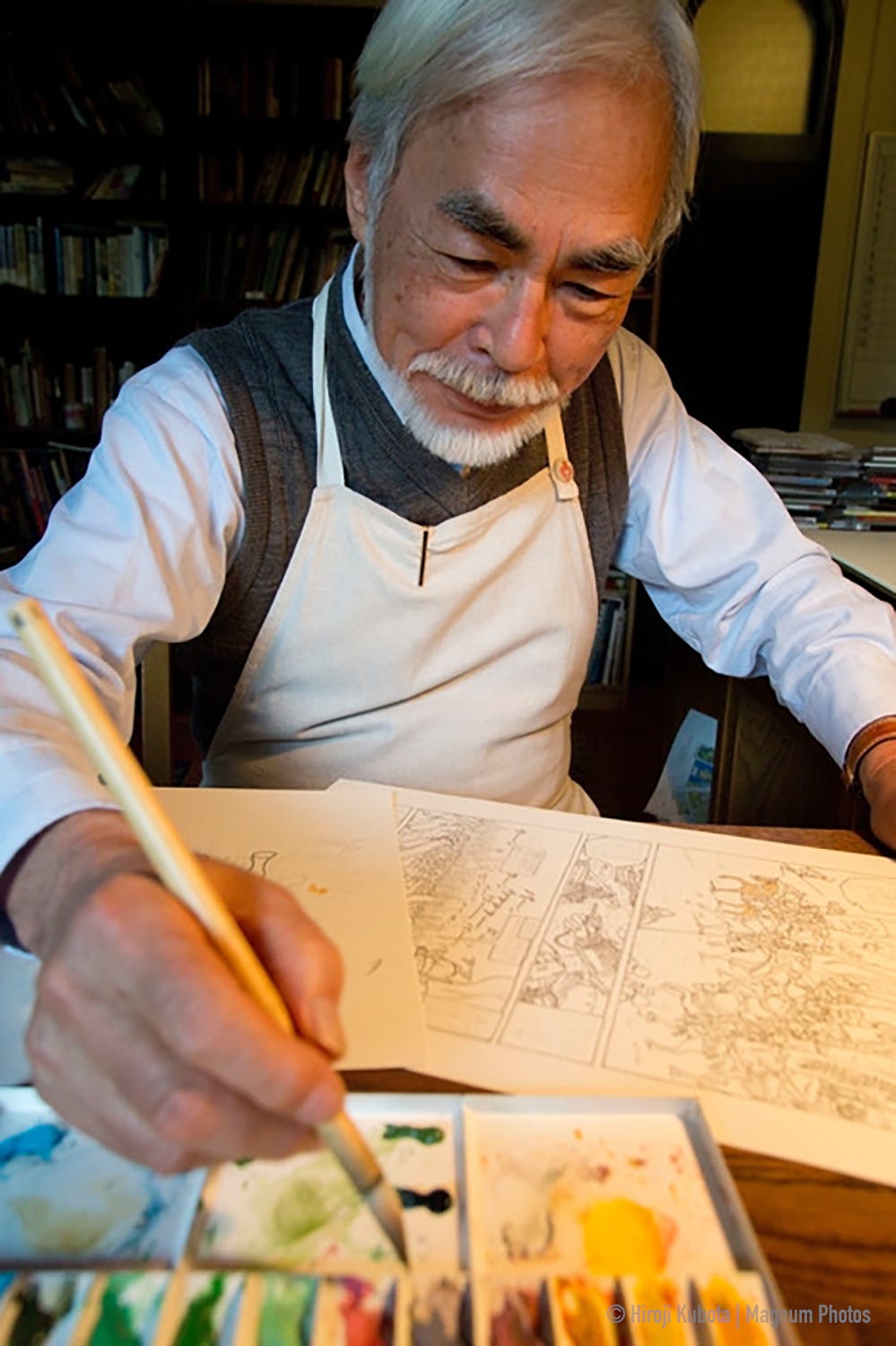
Most creative advice tells you to enjoy the process. The best photographers seem determined not to.
That tension sits at the centre of Hayao Miyazaki’s philosophy of making. The animator, now in his eighties and still working, has spent decades articulating a vision of creative life rooted in Japanese discipline and aesthetic rigour. His core claim is blunt: doing your best only gets you to the starting line. What determines whether your work becomes excellent is how you respond to it once it exists — specifically, whether you refuse to forgive yourself too quickly for its shortcomings.
This runs against almost everything you hear in creative communities today. But Miyazaki’s track record earns his harshness a hearing. And his ideas, transplanted into photography, yield something surprisingly practical: a framework for using dissatisfaction as a precision tool rather than suffering from it as a mood.
Your standards should outrun your output
The gap between what you can see and what you can produce is not a problem to solve. It is the engine of improvement. The moment your standards settle comfortably alongside your current work, you stop growing — even if the work is good.
Daido Moriyama has built an entire career on this principle. His output is enormous: tens of thousands of photographs over six decades, shot in high-contrast black and white with a compulsive, almost physical urgency. Yet he returns to his own archives constantly, re-editing, re-sequencing, discarding images he once printed. His landmark photobook Farewell Photography (originally published in 1972) has been revisited and re-editioned multiple times — most significantly in 2019, when Moriyama returned to the surviving negatives and selected eighty images for a new edition with a completely rethought layout. This wasn’t nostalgia — it was a refusal to let past standards define present ones. Moriyama treats his own body of work the way Miyazaki treats a finished scene: as raw material still subject to scrutiny.
The actionable version of this is specific. After your next serious shoot, select your three strongest images — then write a single sentence for each of the rejected ones explaining precisely why it failed. Not “it didn’t work” or “the composition is off,” but a concrete diagnosis: “the background competes with the subject because I didn’t step two metres to the left.” This habit builds a private vocabulary of failure that becomes, over months, a reliable guide to your own weaknesses.
Weakness as a window
Miyazaki once told a struggling animator that the secret of the world lies inside yourself — that by confronting your own limitations, you gain access to something larger. The idea has roots in Buddhist philosophy, particularly the Kyoto School thinker Keiji Nishitani, whose work on śūnyatā (emptiness) argues that the self is not a fixed entity but a field constituted by its relationships with everything it encounters. You do not exist first and then meet the world; you come into being through that meeting. Your weaknesses, in Nishitani’s framework, are not obstacles between you and reality — they are the very openings through which reality enters.
For photography, this reframes a familiar frustration. The subjects you struggle with, the conditions where your technique breaks down, the images that resist your intentions — these are not evidence of inadequacy. They are the places where your assumptions collide with the actual world, and collision is where discovery happens.
So instead of retreating to subjects you handle well, spend a sustained period — a month, say — photographing only what makes you uncertain. If you shoot portraits confidently, go to landscapes. If you work in colour, strip it out. The goal is not to master the unfamiliar territory quickly but to stay inside the discomfort long enough that it teaches you something your competence never could.
Carolyn Drake’s practice offers a model here. A Magnum photographer who began in documentary work, she shifted progressively toward mixed-media and collage, cutting and reassembling her own prints into images that deliberately undermine photographic authority. Her book Knit Club (TBW Books, 2020) emerged from her collaboration with an enigmatic group of women in a small Mississippi town, incorporating elements of sewing, collage, and staged fiction into a work that blurs the line between documentary and invention. Drake didn’t abandon her documentary instincts; she followed her uncertainty about what a photograph can truthfully represent until it led her to a new form. The weakness — her growing doubt about straight photography’s claims — became the material.
The hundred-person test
Miyazaki’s most provocative suggestion, at least for photographers, is his defence of what he calls being “grumpy”: holding a perspective others find awkward or contrary. If one hundred people would look at a scene and find it beautiful in the same way, photographing that beauty produces a pretty picture but not necessarily a good one. Originality lives in the gap between what everyone notices and what only you would stop for.
The Korean-German philosopher Byung-Chul Han makes a related argument in Saving Beauty. He contends that contemporary culture’s obsession with smooth, frictionless surfaces — what he calls “the smooth” — eliminates the very qualities that make art worth encountering: strangeness, resistance, discomfort. A beautiful image that confirms what the viewer already feels is decoration. An image that introduces friction — an odd framing, something in the composition that doesn’t resolve neatly, a subject the viewer wouldn’t ordinarily find beautiful — has a better chance of doing real work.
Cristina de Middel built her reputation on exactly this friction. The Afronauts (2012), her breakout project, reconstructed the story of Zambia’s failed 1960s space programme using staged, absurdist photographs — oil drums as rocket capsules, a cat in a spacesuit, trainees rolling down hills in barrels. The project was grumpy in the best sense: it refused the easy choice of either solemn documentary or ironic comedy. De Middel photographed a serious subject with wit, and a comic subject with gravity, and the tension between those two registers is what made the work land. She went on to become president of Magnum Photos in 2022, which tells you something about where controlled contrariness can lead.
Before your next shoot, try this: each time you raise the camera, ask yourself whether a hundred other photographers standing in the same spot would take the same picture. If the answer is yes, lower the camera. Wait. Look for the less obvious frame — the one only you would choose, because of the specific way you see. This is not a permanent rule; it’s a training exercise. Its purpose is to interrupt the reflex of photographing what is obviously there and redirect your attention toward what is interestingly there.
What you can’t stop doing
Miyazaki’s final insight may be his sharpest. He describes the creative drive not as motivation or discipline but as compulsion — something that simply cannot be helped. If you truly need to make something, you will make it whether or not it brings pleasure, recognition, or reward. The struggle is beside the point, because the alternative — not making — is worse.
This reframes the question of creative commitment. Instead of asking “how do I stay motivated?”, ask “what do I photograph when nobody is watching?” The subjects you return to when there is no assignment, no audience, no deadline — those are your real material. Everything else is work you can do; that is work you must do. The distinction matters because the compulsive subjects are the ones most likely to sustain a long practice. Motivation fades; compulsion doesn’t.
Newsha Tavakolian’s career illustrates the principle. She began as a photojournalist in Tehran at sixteen, covering conflict and political unrest for international agencies. The work was important and recognised. But her personal projects — Blank Pages of an Iranian Photo Album (2014) and the series Listen (2010–2011), in which she created imaginary CD covers for female singers banned from performing solo under Islamic law — emerged from subjects she could not leave alone: the private lives and stifled aspirations of Iranian women, rendered in staged, saturated tableaux that owed more to painting than to reportage. Tavakolian didn’t plan a career shift. She followed what she couldn’t stop thinking about, and the photojournalism gradually became the secondary practice.
Track your own compulsions honestly. Look at the last two hundred photographs on your camera roll — not the edited selects, but the raw, unfiltered record of what caught your eye. Note the recurring subjects, the repeated compositions, the places you keep gravitating toward. That pattern is data. It tells you what your practice actually cares about, which may be quite different from what you think it cares about.
The growing eye
Dissatisfaction, then, is not a symptom of creative failure. It is evidence that your eye is still outpacing your hand — that you can see more than you can yet make. The day those two capacities draw level is the day your work begins to coast. Miyazaki, in his eighties, reportedly remains unhappy with nearly everything he has made. That unhappiness has not produced misery; it has produced The Boy and the Heron.
The same principle scales down. You do not need Miyazaki’s output or his relentlessness. You need only the willingness to stay inside the gap between what you see and what you capture — and to treat that gap not as a wound but as the clearest sign that your seeing is still alive.
